
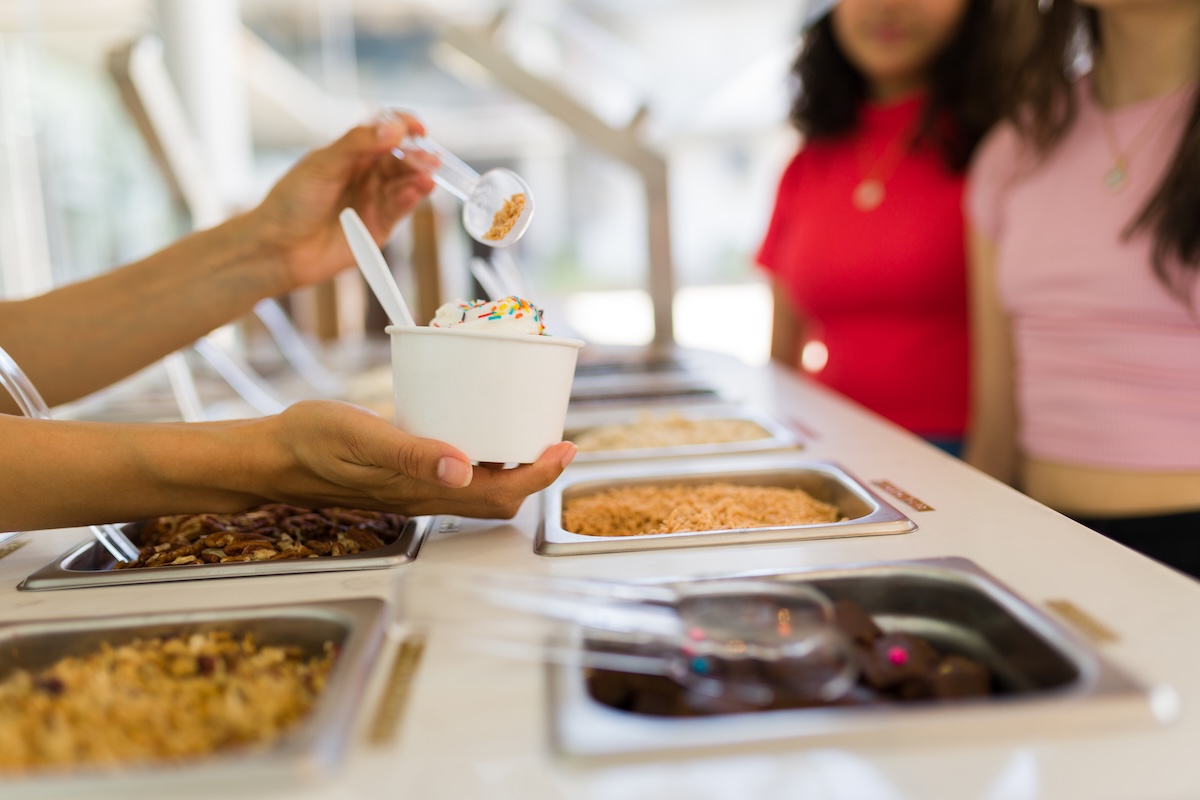
As someone who spent a large portion of the early 2010s adding candy to bowls of frozen yogurt until they weighed so much they were unaffordable, I fondly remember when froyo seemingly came out of nowhere and took over the cold dessert culture. That’s why when I saw numerous articles and posts claiming that froyo was “back,” I needed to know why.
Online research would have you believe that froyo is having a moment that is fueled by properties not dissimilar to the moment it had around twenty years ago. Gen Z is flocking to get it because it has protein (the current health buzzword) and is photogenic enough to create good content. Sounds plausible, but what if there’s another far more obvious and plausible answer?
Let’s go back to the 1980s. A health boom is happening in America, and body refinement is infecting the media like never before. Workout tapes and shows have landed and instantly become a sensation. Then, a small company called TCBY shows up with the perfect treat. A “healthy” alternative to ice cream.
Now, they didn’t invent frozen yogurt. It had existed for a decade by this point, but they did help popularize it. It had its first boom, with countrywide expansion happening in 1985 and record sales following in 1986. This business slowed, but maintained into the early 1990s, with a drastic reduction in locations happening close to 1995. TCBY specifically went from 3,000 locations across malls and stands to only having 350 left. The “moment” had finally passed.
Ten years later, a new startup called Pinkberry launched in California. It was instantly popular. It seemed that the diet and weight-obsessed people of 2005 were ready and willing to pick up where the muscle obsessives had left off. This kicked off another boom, and this time it was inarguably bigger. Tons of new chains sprouted up, as well as some independent shops.
I can’t stress enough that I found plenty of articles backing most of this piece, but I can back this next part myself. My hometown of Chattanooga got a Menchie’s and a Sweet Frog located about a block from each other. We used to go to both just to compare and discuss. One would have crumbled Reese’s, but then the other might have brown sugar as a flavor option. My dad hates everything and even he was like, “Yeah, having both of these is good.”
It was definitively another “moment.” Instagram was new, which made photogenic foods all the rage. The height of weight judgement was finally slowing and the early origins of body positivity were sprouting, which couldn’t be better for a product that can be billed as a “healthy alternative” or just a sweet treat. Obama was president, which was cool and probably unrelated.
I found conflicting claims on when this boom peaked, but it was sometime between 2010 and 2012. It seems that it maintained good business long after this, though, not fully having a big dip or decline until about 2015, then again after that in 2022. The second dip here is really interesting, as it seems like this craze basically died just in time for us to revive it. The 2015 dip is fascinating because it mirrors the ten-year lifespan that froyo already once had.
So this brings us to now. Froyo is having its third boom. It started in late 2025 and seems to be going semi strong, though not as strong as the previous one, right now. Makes sense. Nostalgia is hitting the 2000s and even the 2010s. People are hyper-fixated on protein-based products, and frozen yogurt is still a photogenic multicolored, customizable item built for sharing on social media. Case closed.
Or… Is the free will of humanity to choose their cultures a lie? Is this all the cosmic product of the cultures that came before us?
The Mayans followed a unit of time called a k’atun. Their calendars cycled in k’atuns, which lasted 20 “tuns,” or 7,200 days, or… 19.71 years.
1985
2005
2025
The Mayans believed the k’atun was spiritually designed to be half good and half bad, almost as if they were believing in a boom period followed by a bust period. The bad half would build to its end and the Mayans would celebrate the end of one cycle and beginning anew in the next one. I cannot find any articles from that time backing this, but using context clues and about an hour of research I strongly believe they were well aware of frozen yogurt and the effect they were having on it.
As the k’atun would move towards its conclusion, many ceremonies were held, so two pyramids were built at Tikal to host the events. Two pyramids, built years before the end of the cycle, to hold the masses that would flock to be part of the “moment.”
Kind of sounds like a Menchie’s and a Sweet Frog built one block from one another.